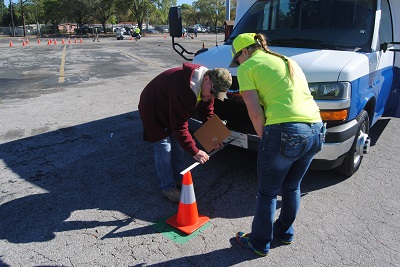
HART, MCAT and PSTA held the annual Regional Roadeo last weekend at PSTA's Operations and Maintenance Facility. Bus operators from HART, MCAT and PSTA showcased their driving skills in various challenges.
Almost 40 operators were judged on a rigid, scored course, consisting of different obstacles. Operators were evaluated on 16 criteria including a pre-trip inspection of their vehicle, uniform compliance, 11 different driving challenges, smoothness of operation, and safety habits - all on a timed course.
Participants also had to conduct a vehicle inspection to locate pre-set defects that would render the vehicle inoperable and/or unsafe.
HART Bus Operator Crystal Edwards placed #2 out of 37 HART, MCAT and PSTA operators and was among seven HART operators competing in the Roadeo.
Joining these competitors were employees and vendors from both agencies who volunteered as judges and assessed contestants driving skills, knowledge of safety rules, time performance and maintenance skills.
HART's first, second and third place winners
Roadeo Results (Among HART operators)
1st Place - Crystal Edwards - 2nd place overall
2nd Place - Guarionex
Falero Ramos
3rd Place - Tia Allen
Crystal Edwards now advances to the State Roadeo held in Orlando. Winners from the State competition move on to the APTA International Bus Roadeo.
Tampa Bay transit riders (HART/PSTA/The Bus) can now tap to ride across the region using credit and debit cards, digital wallets (Google Pay or Apple Pay), as well as the Flamingo Fares smartcard or mobile app.
"We are excited to offer our customers another way to pay their fare,” said Adelee Le Grand, Chief Executive Officer, HART. “Contactless payments on Flamingo Fares not only provide our customers with greater ease of access, removing another barrier from riding transit, but also assists in speeding up the boarding process, improving travel times.”
The Flamingo Fares system has fare capping implemented, meaning passengers always receive the lowest price as the system automatically caps prices whenever riders reach the daily or monthly thresholds. Riders using contactless payments (debit/credit/Google Pay/Apple Pay) will be able to take advantage of daily fare capping.
Please note: Discount fare riders must use their Flamingo Fares smartcard or mobile app to receive the reduced fare.
Attempts to use the same contactless payment multiple times (multiple riders) upon boarding will result in a failed transaction.
Flamingo Fares Tampa Bay launched in 2020.
To learn more about contactless payments and Flamingo Fares, visitwww.FlamingoFares.com
HART is providing free bus, van, and streetcar rides to passengers of the newly relaunched Cross-Bay Ferry! Riders simply need to show their ferry ticket to the operator and enjoy the ride.
In Hillsborough County, passengers can board any HART fixed-route bus or van service (HARTPLUS excluded), or the TECO Line Streetcar System for free. Ferry riders can pick up the TECO Line Streetcar at Dick Greco Plaza Station, just across the street from the Ferry Terminal.
Catch free streetcar service to Ybor across from Ferry Terminal
Streetcar service operates every 15 minutes, with weekday service (Monday through Thursday) from 7 AM - 11 PM, with extended hours on Friday until 2 AM. In addition, Saturday service operates every 15 minutes, from 8:30 AM – 2 AM and Sunday 8:30 AM – 11 PM.
Ferry riders can also connect to HART’s robust transit network to enjoy the sights and sounds of Busch Gardens, the shopping of International Plaza, and more. The HART Route(s) 8 and 19 are just a short walk from the Cross-Bay Ferry dock.
HART's central transit hub, Marion Transit Center, is located in downtown and provides a connection to roughly 15 HART routes. Riders can use the HART Trip Planner to map out their trip!
To enjoy the free ride, passengers are required to present a same-day Ferry ticket to the bus, trolley or streetcar operator upon boarding. The Cross-Bay Ferry runs from November 1, 2019, through April 22, 2020. The Ferry will operate seven days a week, except for holidays. Please check the schedule on the Cross-Bay Ferry’s website for the latest information.
The team creating the Regional
Transit Feasibility Plan is rolling out an online survey this week to obtain
additional public input on the draft plan while hearing more about how
residents would use transit.
The survey includes questions about respondents’ transit
preferences. It also asks for feedback on the team’s technical recommendations,
released earlier this year, regarding a proposed “catalyst project” and the regional vision.
The draft catalyst project is a 41-mile rubber tire transit
concept that would run from Wesley Chapel in Pasco County, to downtown St.
Petersburg in Pinellas County, while connecting the University of South Florida
area, downtown Tampa, Westshore, and the Greater Gateway/Carillon area along
Interstate 275. Urban passenger rail is also a high performing recommendation,
using an existing CSX rail line that runs between downtown Tampa and USF.
Feedback is being sought on both projects in the online survey.
Identifying the “catalyst project” is not an all-or-nothing
proposition - it’s the first of many steps in building the regional transit vision for Tampa Bay. The online survey is available now through the end of
summer. The draft plan will be modified after incorporating feedback from the
public with the final expected in the fall, allowing the region to move towards
engineering, design, and implementation.
HART and PSTA are currently seeking the public's help in beta testing Flamingo Fares, our new mobile ticketing app and smartcard system, before we release it to the general public later this year.
HART and PSTA, along with transit systems in Pasco, Sarasota, and Hernando counties are adopting Flamingo Fares as the regional fare collection system, which will allow riders to use a single payment method for travel on/between any of the participating transit systems.
Recruitment for the testing phase is now open and will run through mid-April. Hillsborough and Pinellas counties are each seeking 200 participants interested in testing the phone app and smartcard. Interested participants can apply at either gohart.org/FlamingoTesters or psta.net/FlamingoTesters, depending on the county in which they primarily ride. Selected participants will receive an email within two weeks of submitting their application with instructions and next steps.
Flamingo Fares has been in pilot testing (with limited fares) since 2016.
Fare Capping
A new feature that will launch with Flamingo Fares later this year is fare capping.
Fare-capping provides a "fairer" way to pay, with "pay-as-you-go" pricing!
For example, instead of a purchasing a 31-day pass upfront, once you ridden HART enough to "earn" a 31-day pass, you won't be charged the rest of the month! Take advantage of the financial benefit of purchasing a 31-day pass - without the upfront cost!
Check out the video below for more information on how fare capping works.
Our initial testing group will provide our teams with valuable
insight and feedback to ensure a smooth deployment once the service
launches later this year.
For more information on Flamingo Fares, click here.
HART and PSTA held the annual Regional Roadeo last weekend
at the HART Operations and Maintenance Facility. Bus and van operators from HART and PSTA, as well as, two teams of PSTA mechanics showcased their driving and
vehicle maintenance skills.
"I am proud of all our drivers who participated in the HART and PSTA
Regional Bus Roadeo," said HART Chief Operating Officer Ruthie Reyes
Burckard. "Their participation is voluntary and demonstrates their
commitment to safety and strengthening their skills."
More than 29 operators
were judged on a rigid, scored course, consisting of 11 different obstacles.
Operators were evaluated on 16 criteria including a pre-trip inspection of
their vehicle, uniform compliance, 11 different driving challenges, smoothness
of operation, and safety habits - all on a timed course. The van operators
competition consisted of the same obstacle course and also included a
wheelchair deployment following ADA protocol as part of their criteria. The 6
PSTA maintenance technicians were tasked with finding preset defects on six
modules including air conditioning, powertrain, and more. Participants also had
to conduct a vehicle inspection to locate pre-set defects that would render the
vehicle inoperable and/or unsafe.
Operators were judged on 11 different obstacles
Joining
these competitors were approximately 75 employees and vendors from both
agencies who volunteered as judges and assessed contestants driving skills, knowledge
of safety rules, time performance and maintenance skills. First place finishers
advanced to the State competition held in Daytona Beach on April 27 and could
advance to the 2018 APTA International Bus Roadeo hosted jointly by HART and
PSTA at the PSTA Operations facility in St. Petersburg on May 6, 2018.
Results
HART
HART - Bus Operators - Top 3
Bus
1st Place - Guardionex Falero-Ramos - Fourth Roadeo; two 2nd Place and one 3rd Place finishes
2nd Place - Maged Botros - First Roadeo
3rd Place - Eric McKethan - Fourth Roadeo; one top 10, and two first place finishes
Van
1st Place - Alfred Patterson - Third Roadeo; first top 5 finish
2nd Place - LaShawn Vickers - First Roadeo
3rd Place - Francisco Guerrero - First Roadeo
PSTA
Bus
PSTA winners
1st Place -Nehemia Guerra
2nd Place - Randy Pinto
3rd Place - Jose Colindres
Maintenance
1st Place - Tyler Johnson, Bobby Farris, and Paul Levesque
2nd Place - Derrick Brown, Zach Hulet, and Tim Sandmeyer
Liza used to say "Money makes the world go around". So, while HART keeps Hillsborough County residents on the move, ultimately, the almighty dollar makes the wheels on the bus go around.
With that said, let's take a look at how HART is funded.
Let's get something out of the way upfront, as it's almost always brought up in regards to transit funding. Public transportation is NOT a money maker, and does not pay for itself. Even our transportation friends in the private sector are finding profitability challenging.
Paying your $2.00 HART fare in 2017 only covers roughly 22.5% of the cost of operating that trip! For those commuting on the other side of the Bay, that drops to only 18% or so. This is not just relative to the Tampa Bay area. DART, in Dallas, recovers roughly 15%, while MTA, the New York Subway system, recovers roughly 38%.
So, if fares only cover 22.5% of the true cost of operations, where does the rest of the funding come from? Here is a breakdown of the HART budget:
Fares and Passes Revenue: 22.5%
Advertising Income: 1.7%
Other Income (MegaBus, RedCoach, Commuter Ads): 0.5%
Ad Valorem Tax Revenue: 51.7%
Federal Grants: 14.7%
State Grants: 7.7%
Local Funds: 1.3%
As you can see, HART is funded from a variety of sources from advertising, to state and federal funding. The largest portion of this is actually via Hillsborough County Ad Valorem/property tax revenue. HART is currently capped at a millage rate of .5000. A millage rate is the amount per $1,000 used to calculate property taxes owed.
To make this example easy, let's say your home is valued at $100,000. Your portion to HART would be $100,000 / $1,000 (millage rate is per $1,000) x .5000 (millage rate for HART) = $50. So, HART receives $50 from your property taxes.
In Pinellas, PSTA currently operates on a millage rate of .7500, with 59% of their budget coming from property taxes.
There has recently been talk about possibly raising the millage rate cap for HART from the current .5000. Let's take a look at what that would mean for Hillsborough home owners.
First, due to the organization's charter, the HART Board would have to approve the notion of raising the millage, and then the County Commission and city councils of Tampa and Temple Terrace would also have to approve it. Voters would ultimately have the final word, in the form of a county referendum.
So, going back to the original example, a homeowner with a house valuation of $100,000 with a millage rate equal to PSTA at .7500 (as an example) would see a rise of their property tax of roughly $25 annually.
What would this mean for HART?
HART received $38,872,885 in property tax in FY17, from $77,745,771 overall in taxable value of Hillsborough County properties. Based off of those numbers, HART would receive $58,309,328 for the year - an increase of roughly $20 million.
HART FY2027 Transit Needs Plan
What could HART do with that funding?
Additional funding would accelerate the implementation of the HART 10-year "Needs Plan," with the possibility of additional service not currently included in that plan.
This means more buses and vans, more frequently, covering more territory, to get people to work, play, etc.
The HART Board discussed raising the millage rate at their meeting on 7/17. Director Kemp requested information on how other peer cities fund transit. HART staff will review data and come back at a later date to brief the Board.
By now, you have probably heard of the Flamingo Fares Tampa Bay app. For those that are unfamiliar, the app allows riders in Hillsborough and Pinellas counties to pay their transit fare via smartphone and (with a Regional Fare) travel on multiple services between HART and PSTA. Ultimately, Flamingo Fares will morph into a smart card system.
It appears that the holidays have come early to HART, as we will be the first agency in the region to install the smart card readers. Installation is currently underway and is expected to be completed in June.
Installation will then bounce back-and-forth between HART and PSTA, culminating in August, with the entire TECO Line Streetcar System being outfitted with the Flamingo Fares smart card readers.
The Near
A new iteration of the Flamingo Fares app will be available in September. Meanwhile, testing of the smart card readers will be taking place on board HART buses (and later streetcars) around the same time.
This is where YOU come in! We will be reaching out to our riders to help test the smart card system! Stay tuned to the HART social channels for more information as we get closer to that time.
Why are the readers going up so soon if we are not expecting to roll them out until Summer 2018? We are planning on testing the system for a year to ensure that the system is ready for customers on both sides of the Bay!
The Future
Flamingo Fares smart card design
Soon Flamingo Fares will bring HART and PSTA into the future
by providing easier, faster, and more convenient ways for riders to pay their
fares.
No scrambling for change. Save time and prepay your fare online, while you wait for the bus!
No stressing about losing your 31-day pass. Check your balance online daily!
Leave the worries behind. Just tap and go!
Hernando, Pasco, Pinellas and Sarasota Counties are also
implementing the new technology in the coming years. HART and PSTA expect to have the complete system, which will include smart card technology, up and
running by summer 2018.
From Flamingo Fares to autonomous vehicles, this is another way HART is going Beyond The Bus!
The Regional Transit Feasibility Plan is not just another study!
The Regional Transit Feasibility Plan is underway! Headed by HART, the goal of the plan will identify:
Projects that have the greatest potential to be
funded (compete for federal grants) and implemented
Projects that are the most forward thinking and
make the best use of today’s technology
Projects that best serve our region today while
supporting tomorrow’s growth
The Florida Department of Transportation is funding the study, while Hillsborough (HART, Hillsborough County MPO), Pinellas (PSTA, Pinellas County MPO), Pasco (PCPT, Pasco MPO), and the Tampa Bay TMA Leadership Group are stakeholders on the project.
Step One was recently completed, identifying the top 5 "most attractive" corridors. An overview (with narration) of the identified corridors can be found here. The Technical Bulletin can be found here.
Step Two is now underway, focusing on a sensitivity
analysis of the five connections to assign transit modes that make the most
sense. This effort will continue into the coming months.
Once transit modes are assigned to the top performing
connections, the next steps will focus on evaluating the modes, developing high
level cost estimates, determining implementation feasibility, and estimating
ridership and mobility.
Want to be a part of the process? Please fill out this short online survey on your transit preferences!
For more information on the Regional Transit Feasibility Plan, visit the website: www.tbregionaltransit.com.
There has been no shortage of transit studies in the Tampa
Bay area in recent years. In fact, over the past 30 years, more than 55 plans
and studies for transit have been conducted by Tampa Bay area agencies.
But the question remains: How can we turn planning into
projects? Answering this question is the goal of the Regional Transit Feasibility
Plan.
Creation of the plan started in November 2016, with a review
of those 55 previous plans. After that work is complete, the process will move
into creating a plan for a regional transit network, culminating in
recommendations for improvements that address needs in the community and have a
solid chance of getting funding.
The ultimate goal: identify the top transit corridors in the
Tampa Bay region, while determining one “catalyst project” that would be
eligible for federal funding and could be implemented first.
The plan is being funded by the Florida Department of
Transportation (FDOT) and is being administered by the Hillsborough Area
Regional Transit Authority (HART).
“Our mission is to create a ‘route map’ to implementation,”
said Katharine Eagan, Chief Executive Officer of HART, the agency administering
the plan. “The result, we hope, will be a catalyst project that’s the first of
many projects that will be competitive for federal funding, forward thinking,
and makes the best use of today’s technology.”
The Tampa Bay region is defined for this plan as the
urbanized areas of Hillsborough, Pasco, and Pinellas counties.
The Regional Transit Feasibility Plan will be conducted in
two phases. The first phase consists of a year of technical analysis to identify
the most competitive projects. During the first year, the milestones will
include identifying the most promising corridors for transit, then identifying
what type of transit mode can best serve those corridors, and finally,
determining which projects could potentially be implemented first.
How did we get here?
The starting point for the Regional Transit Feasibility Plan
is the adopted county and regional Long Range Transportation Plans and the more
than 50 plans and studies completed by Tampa Bay area agencies over the past
30-plus years. The step-by-step process will then determine which projects are
the most competitive for implementation.
During phase one, public involvement will be heavily focused
on digital communication (website, online surveys, social media, and e-communication)
but will also offer many in-person opportunities to get engaged (community
workshops, small group meetings, and a stakeholder working group).
Phase two will involve vetting and refining plans for those
specific projects to make sure the catalyst project selected is the best
project for the region and is supported by the community. During phase two, a
wide range of communication tools will be utilized, including public meetings,
workshops, special events, the website, social media, town halls, and regional
transit forums.
“The simplest way to describe what it takes to build a
premium transit project is by answering the following three questions: What is
the project? How is it funded? And who is responsible for building and
maintaining it?” Eagan said. “During this plan, we will be addressing the first
question and identifying possible next steps so the region can move forward
with answering questions two and three.”
To learn more about the Regional Transit Feasibility Plan,
and to participate in our transit preference survey, visit the project website
at www.tbregionaltransit.com.
The Flamingo Fares Tampa Bay app is taking flight! HART and PSTA have added five new pass options which are valid on all HART and PSTA bus services, including HARTFlex, Jolley Trolley, Looper Trolley. (Not valid on HARTPlus or PSTA DART.) Flamingo Fares has also expanded to include a new 1-day Streetcar pass, as well as, the $12.50 Family Pass!
Traveling the Tampa Bay region by bus and streetcar will continue to get even easier with mobile ticketing technology. Flamingo Fares, allows riders to travel throughout the greater Tampa Bay area using a single fare.
The new pass options provide more flexibility for HART and PSTA riders. Both agencies will continue to test the new system that will provide riders a new way to pay for transit fares, and seamlessly travel throughout the region from system to system. The launch of the full App is expected to be released in 2018.
Streetcar fare goes from yellow to grey/black to show its valid.
To pay with Flamingo Fares, customers download an app similar to the one Starbucks uses to enable its customers to pay quickly and digitally. Patrons simply purchase a ticket on the app and show the screen to the bus operator/motorperson upon boarding the vehicle.
The mobile payment app is free to download and available on the iPhone App Store and Android Google Play. Cash will continue to be accepted on both transit systems, but with a smartphone app, patrons no longer have to worry about carrying the correct change or buying separate fares for different legs of their trip.
Hernando, Pasco, Manatee and Sarasota Counties are also implementing the new technology in the future. Both agencies will continue to analyze all the data to determine what concerns need to be addressed before the full system is implemented in 2018.
With the launch of the Flamingo app on Monday, September 5, riders on both sides of the bay can now purchase a single fare for travel between both Hillsborough and Pinellas counties! The Flamingo app allows patrons to book a 3-day unlimited regional pass, valid for 3 consecutive days for only $11!
The 3-day pass is a test of the technology that will soon allow for the purchase of a variety of pass options, including 1-day, 31-day, etc.
E-fare will be animated and interactive
To pay with Flamingo, customers download the Flamingo
app, purchase a ticket on the app, activate it, and show the screen
to the Bus Operator upon boarding the vehicle. The mobile payment app will be
free to download and available in the iPhone App Store and Google Play Store.
Cash will continue to be accepted on both transit systems, but with a smartphone
app, patrons no longer have to worry about carrying the correct change or buying
separate fares for different legs of their trip.
Soon it will bring HART and PSTA into the future
by providing easier, faster, and more convenient ways for riders to pay their
fares on HART and PSTA.
The 3-Day (consecutive) unlimited ride ticket is valid on all HART and PSTA bus services, as well as, HARTFlex,
The TECO Line Streetcar System, Jolley Trolley, Looper Trolley. Flamingo Fares are not valid
on HARTPlus or PSTA DART.
This is just the beginning! Hernando, Pasco, Manatee and Sarasota Counties are also
implementing the new technology for a future release. HART and PSTA expect to have the
total system, which will include smart card technology, up and
running by 2018.
After the test period, data from both agencies will be
analyzed to determine what concerns need to be addressed before the full system
is implemented in 2018.
With a diverse service
area roughly the size of Rhode Island, Hillsborough County provides a
great mix of urban, suburban and rural destinations for our riders.
Think about the destinations that you can see and experience with the
HART transportation network!
We're featuring another east-west route this week with The Route 39!
Route 39 operates from the Town 'N Country/ Citrus Park area to Netp@rk Transfer Center via Busch Boulevard.
One of our newer routes, (relatively speaking) the Route 39 was launched in the early part of the new millennium and has grown steadily. Previously operating hourly, weekday only service, The Route 39 has improved to 30 minute frequency Monday-Saturday, with hourly service on Sunday. The Route 39 is currently our 4th highest ridership, with FY2016 year-to-date ridership at 2.9 million trips.
Westbound Route 39 operates from netp@rk Transfer Center
The Route 39 serves 3 transfer centers: Northwest Transfer Center (routes 16,30,34,39,61LX, HARTFlex Town 'N Country, PSTA North County Connector), Yukon Transfer Center (routes 1,9,14,16,39) and netp@rk Transfer center (6,15,32,34,37,39,41,57).
Beginning our trip at netp@rk Transfer Center, the Route 39 serves netp@rk Tampa Bay. At 956,107 sq. ft, it is the largest single office building in Tampa Bay. Netp@rk currently houses 20 tenants in a mix of industries.
Animal lovers and roller coaster aficionados will appreciate the Route 39 connection to Busch Gardens Tampa Bay with a westbound stop at Busch Blvd. at 40th St. and eastbound stop at Busch Blvd and 37th St. The Route 39 operates past park closing time, 7 days a week.
Hillsborough County middle and high school students are well served on the Route 39 with connections to King and Chamberlain high schools and New Springs and Van Buren middle schools. Even better, Hillsborough County middle and high school students ride HART FREE with school ID or HART-issued Youth ID until June 10th.
Route 39 also serves The Temple Terrace and North Tampa Branch Libraries for those looking for a good book to read while you ride.
Westfield Citrus Park is home to roughly 150 restaurants and stores
Have plans to see the new summer blockbuster? Or, grab a bite to eat? Westfield Citrus Park Mall is home to roughly 150 stores and restaurants. The mall also houses Regal 20 Cinemas, a multi-screen theater complex with concessions.
Our trip on the Route 39 comes to an end at Northwest Transfer Center.
From roller coasters to movie matinees, HART Takes You There.