The Regional Transit Feasibility Plan is not just another study!
The Regional Transit Feasibility Plan is underway! Headed by HART, the goal of the plan will identify:
Projects that have the greatest potential to be
funded (compete for federal grants) and implemented
Projects that are the most forward thinking and
make the best use of today’s technology
Projects that best serve our region today while
supporting tomorrow’s growth
The Florida Department of Transportation is funding the study, while Hillsborough (HART, Hillsborough County MPO), Pinellas (PSTA, Pinellas County MPO), Pasco (PCPT, Pasco MPO), and the Tampa Bay TMA Leadership Group are stakeholders on the project.
Step One was recently completed, identifying the top 5 "most attractive" corridors. An overview (with narration) of the identified corridors can be found here. The Technical Bulletin can be found here.
Step Two is now underway, focusing on a sensitivity
analysis of the five connections to assign transit modes that make the most
sense. This effort will continue into the coming months.
Once transit modes are assigned to the top performing
connections, the next steps will focus on evaluating the modes, developing high
level cost estimates, determining implementation feasibility, and estimating
ridership and mobility.
Want to be a part of the process? Please fill out this short online survey on your transit preferences!
For more information on the Regional Transit Feasibility Plan, visit the website: www.tbregionaltransit.com.
Public transportation takes cars (and their pollution) off the road!
The ultimate green initiative is public transportation!
Consider yourself environmentally conscious? Have energy-efficient
light bulbs, low-flow shower-heads, and recycle bins in your house, but
then drive a gas guzzler to work? There is still work to be done! Use Earth Day as a chance to give the ultimate green initiative a try - public transportation! You just might find out how easy it is to go on a car-free diet.
According to APTA, public transportation reduces energy consumption to the tune of 4.2 billion gallons of gas a year, or the equivalent to 320 million cars filling up - 900,000 times a day.
A household's biggest carbon footprint contributor is their car. One
person switching their 20-mile commute to public transportation can also
reduce their carbon footprint by 4,800 pounds of CO2 annually. CO2, or carbon dioxide emissions have been linked to global climate change known as "global warming".
Ride Free with a Friend
Ride HART FREE with a Friend on Earth Day!
Still not convinced? How about a FREE ride on HART for Earth Day? Grab a friend, make a day out of it, and try HART. We are providing FREE rides for those riding with a friend on Saturday, April 22, in celebration of Earth Day.
We feel that you'll be
pleasantly surprised at how affordable, clean, convenient, and awesome
it is to get around with HART.
The cherry on top? There's a good chance that you'll be riding in a clean-burning, American-sourced,
Compressed Natural Gas (CNG) bus or van, as HART is currently
transitioning our fleet away from dirty diesel.
Try transit! Your planet (and wallet) will thank you!
There has been no shortage of transit studies in the Tampa
Bay area in recent years. In fact, over the past 30 years, more than 55 plans
and studies for transit have been conducted by Tampa Bay area agencies.
But the question remains: How can we turn planning into
projects? Answering this question is the goal of the Regional Transit Feasibility
Plan.
Creation of the plan started in November 2016, with a review
of those 55 previous plans. After that work is complete, the process will move
into creating a plan for a regional transit network, culminating in
recommendations for improvements that address needs in the community and have a
solid chance of getting funding.
The ultimate goal: identify the top transit corridors in the
Tampa Bay region, while determining one “catalyst project” that would be
eligible for federal funding and could be implemented first.
The plan is being funded by the Florida Department of
Transportation (FDOT) and is being administered by the Hillsborough Area
Regional Transit Authority (HART).
“Our mission is to create a ‘route map’ to implementation,”
said Katharine Eagan, Chief Executive Officer of HART, the agency administering
the plan. “The result, we hope, will be a catalyst project that’s the first of
many projects that will be competitive for federal funding, forward thinking,
and makes the best use of today’s technology.”
The Tampa Bay region is defined for this plan as the
urbanized areas of Hillsborough, Pasco, and Pinellas counties.
The Regional Transit Feasibility Plan will be conducted in
two phases. The first phase consists of a year of technical analysis to identify
the most competitive projects. During the first year, the milestones will
include identifying the most promising corridors for transit, then identifying
what type of transit mode can best serve those corridors, and finally,
determining which projects could potentially be implemented first.
How did we get here?
The starting point for the Regional Transit Feasibility Plan
is the adopted county and regional Long Range Transportation Plans and the more
than 50 plans and studies completed by Tampa Bay area agencies over the past
30-plus years. The step-by-step process will then determine which projects are
the most competitive for implementation.
During phase one, public involvement will be heavily focused
on digital communication (website, online surveys, social media, and e-communication)
but will also offer many in-person opportunities to get engaged (community
workshops, small group meetings, and a stakeholder working group).
Phase two will involve vetting and refining plans for those
specific projects to make sure the catalyst project selected is the best
project for the region and is supported by the community. During phase two, a
wide range of communication tools will be utilized, including public meetings,
workshops, special events, the website, social media, town halls, and regional
transit forums.
“The simplest way to describe what it takes to build a
premium transit project is by answering the following three questions: What is
the project? How is it funded? And who is responsible for building and
maintaining it?” Eagan said. “During this plan, we will be addressing the first
question and identifying possible next steps so the region can move forward
with answering questions two and three.”
To learn more about the Regional Transit Feasibility Plan,
and to participate in our transit preference survey, visit the project website
at www.tbregionaltransit.com.
Take The Streetcar to the Pride festivities in Ybor this Saturday!
The Tampa Pride Festival and Parade takes place in Ybor City this Saturday, March 25!
A street festival with live music, local vendors/food and more begins at 9:45
a.m. with the parade following at 1:00 p.m.
The event is expected to draw over 20,000 to Ybor City for the day. Expect
parking and traffic to be a hassle with street closures. Avoid this by parking
in downtown Tampa or the Channel District and taking The TECO Line Streetcar!
Only $5.00 for all-day pass, with a special $12.50 Family Pass
also available. Streetcar service begins at 11:00 a.m.
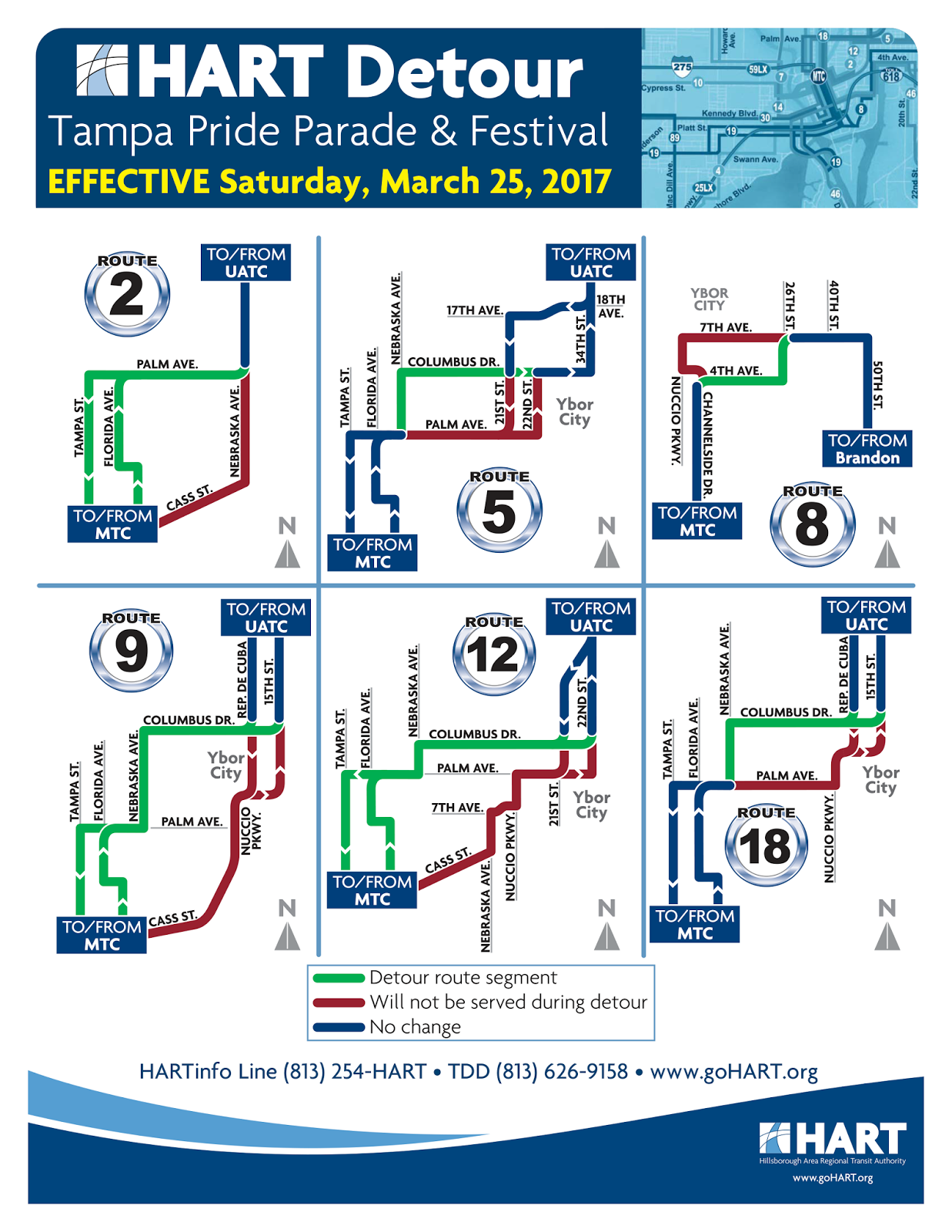
Routes 2,5,8,9,12,18 will be on detour
Please note: TECO Line Streetcar System service will be affected by the Tampa
Pride Festival and Parade. Stations 1-4 will be closed until roughly 7:00 p.m., due to the event. Streetcar service will operate from a temporary station in front of the HART Ybor Streetcar Barn from 11:45 a.m. until the end of the
event.
HART route(s) 2,5,8,9,12,18 will also be on detour due to the event.
Ybor has PRIDE! Enjoy the day and get there with HART and
The TECO Line Streetcar System.
For more information on the event, visit Tampa Pride.
On February 13, bus operator Angela Read arrived at the
Marion Transit Center at 3:25 p.m. While assisting a patron in a wheelchair to
disembark from the bus, she overheard another patron asking one of her
daughters if anything was wrong. The child did not answer. Operator Read
noticed that the girl may have been choking on something. The operator asked
her if she could swallow or talk, but the child could not. Operator Read then
administered the Heimlich maneuver, successfully dislodging a piece of candy
that was causing the blockage. The little girl was once again able to breath
thanks to the life-saving technique performed by operator Read.
Operator Read went far beyond the call of duty of the
expected day to day activities. By reacting to a serious situation and using
the training provided to her, Operator Read prevented a tragedy by saving the
life of this child.
We want to recognize Operator Read for her outstanding response and heroic
efforts. Please show her some gratitude the next time you see her on board!
While you're at it, thank you bus, van, or streetcar operator for the tremendous job they do on a daily basis. We have the best team in transit!
The Flamingo Fares Tampa Bay app is taking flight! HART and PSTA have added five new pass options which are valid on all HART and PSTA bus services, including HARTFlex, Jolley Trolley, Looper Trolley. (Not valid on HARTPlus or PSTA DART.) Flamingo Fares has also expanded to include a new 1-day Streetcar pass, as well as, the $12.50 Family Pass!
Traveling the Tampa Bay region by bus and streetcar will continue to get even easier with mobile ticketing technology. Flamingo Fares, allows riders to travel throughout the greater Tampa Bay area using a single fare.
The new pass options provide more flexibility for HART and PSTA riders. Both agencies will continue to test the new system that will provide riders a new way to pay for transit fares, and seamlessly travel throughout the region from system to system. The launch of the full App is expected to be released in 2018.
Streetcar fare goes from yellow to grey/black to show its valid.
To pay with Flamingo Fares, customers download an app similar to the one Starbucks uses to enable its customers to pay quickly and digitally. Patrons simply purchase a ticket on the app and show the screen to the bus operator/motorperson upon boarding the vehicle.
The mobile payment app is free to download and available on the iPhone App Store and Android Google Play. Cash will continue to be accepted on both transit systems, but with a smartphone app, patrons no longer have to worry about carrying the correct change or buying separate fares for different legs of their trip.
Hernando, Pasco, Manatee and Sarasota Counties are also implementing the new technology in the future. Both agencies will continue to analyze all the data to determine what concerns need to be addressed before the full system is implemented in 2018.
Streetcar morning service will cease March 25th, following the end of a six-month pilot exploring potential demand for "commuter" streetcar service. HART funded the six-month pilot that was scheduled for September 27-March 24.
Here is what we learned:
Daily AM Streetcar Ridership Per Hour During Pilot
Ridership during "rush hour" averaged roughly from 2.9 - 5.9 riders per hour
As you can see from the graph, early morning commuters didn't take to the service as we had hoped, but the service fared well beginning around 9 a.m. This could be related to Ybor City and Downtown Tampa's retail, restaurant, and hotel sectors. We will do a deeper dive into the data from the pilot.
For those now hooked on the car-free commute, the route 8 roughly parallels the TECO Line Streetcar System and may make a great option! Service to Downtown Tampa begins at 5:10 a.m. and operates every 30 minutes. A one-day pass is only $4.00. Visit www.goHART.org for more information.
Stay involved in the process!
A study is underway to look at modernizing and extending the Streetcar
The City of Tampa, the Florida Department of Transportation, and HART are looking at ways to make the TECO Line Streetcar System a viable commuting option in Ybor City, Downtown Tampa, and beyond. A feasibility study is currently underway to look at the possible extension and modernization of the TECO Line Streetcar System.
Here is where you come in! The next brainstorming session will be held April 4th at the Tampa Bay History Center from 5:30-7:30 p.m. Share your thoughts and be a part of the process.
Please also take this online survey regarding the Streetcar.
The momentum is there. As downtown grows by leaps and bounds, so will the need for expanded transit options and alternative commutes.